
Mini Split Copper Pipe Size Chart (From a Working Installer)
The mini split copper pipe size chart I use daily comes from years of sizing and connecting mini split line sets in and around Madison, Wisconsin and the question I get asked most often is which copper pipe goes with which unit.
- Written by
- A working HVAC tech
- Updated
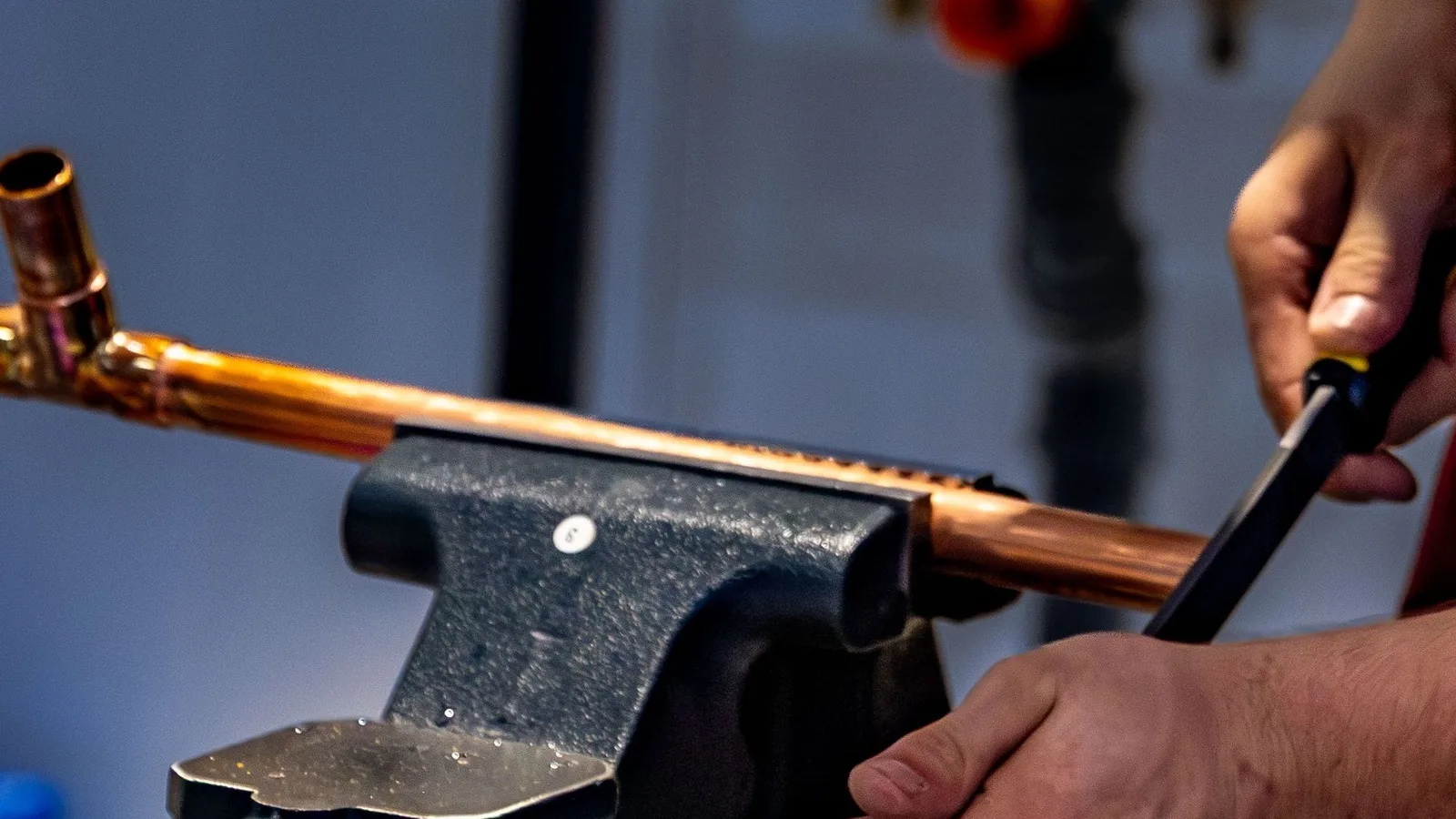
In theory the answer might be simple, but in practice it can get messy because every brand puts out its own specs. Below is the chart I wish someone had given me on my first job, plus the field-level detail that can help you keep it honest.
Key Takeaways
-
Most residential mini split line sets are 1/4" x 3/8", 1/4" x 1/2", or 3/8" x 5/8". With any generic copper pipe size chart, the installation manual that came with the equipment is what always wins.
-
For the line set size you need, the indoor unit (air handler) usually sets it, while the outdoor condenser sets limits on total length and how much height difference you can have.
-
Using the wrong pipe size can reduce efficiency or damage the compressor. Tubing that is too small cuts down on the flow of refrigerant. Tubing that is too big slows down vapor velocity and keeps the compressor from getting enough oil.
-
Different brands use different flare torque values even for the same pipe sizes. On my Daikin AXVJU jobs, the flare torque for the 1/4" pipe is 13.3 ft-lb. Mitsubishi's spec for the same outside diameter is lower. A "universal" torque chart is not safe.
-
Homeowners can plan routing and measure length, but any work that changes refrigerant charge beyond the pre-charged length is EPA-regulated and requires a licensed tech.
How Mini Split Copper Pipe Sizing Actually Works
Copper pipe size for mini splits goes up with cooling capacity measured in BTUs. Based on pressure drop through the refrigerant lines at a given capacity, refrigerant type (R-410A on most units sold in the 2020s), and the velocity needed to carry compressor oil back through the suction line, the manufacturer figures out tube diameter. At the outdoor compressor, the suction line returns low-pressure refrigerant vapor. If that line is too small, oil pools in the piping instead of making it back.
For ductless systems in typical homes around Madison, the common sizes I install are:
-
1/4" liquid x 3/8" suction
-
1/4" liquid x 1/2" suction
-
3/8" liquid x 5/8" suction
Mini Split Copper Pipe Size Chart by Capacity
The chart below covers typical R-410A single-zone mini split setups. I built it from manufacturer specs and field experience, not guesses.
| Capacity (BTU) | Liquid Line OD | Suction Line OD | Line Set Notation | Common Application |
|---|---|---|---|---|
| 6,000 - 9,000 | 1/4" | 3/8" | 1/4" x 3/8" | Bedroom, home office |
| 12,000 (1 Ton) | 1/4" | 3/8" | 1/4" x 3/8" | Single room, small living area |
| 15,000 - 18,000 (1.5 Ton) | 1/4" | 1/2" | 1/4" x 1/2" | Larger family room, studio |
| 24,000 (2 Ton) | 3/8" | 5/8" | 3/8" x 5/8" | Large living area, garage |
| 30,000 - 36,000 | 3/8" | 5/8" | 3/8" x 5/8" | Open-plan space, multi-zone branch |
A 1 Ton AC (12,000 BTU) requires a 3/8" suction line. A 1.5 Ton AC requires a 1/2" suction line. A 2 Ton AC requires a 5/8" suction line. Common line set sizes include 1/4" x 3/8" and 3/8" x 5/8", with the 3/8" x 5/8" pair used for larger-capacity systems.
Line Set Sizes 1/4, 3/8, 1/2, and 5/8
Each common size has a specific job it does in the system:
-
The 1/4" copper pipe is almost always the liquid line on residential mini splits. The liquid line is what carries high-pressure refrigerant from the outdoor unit to the expansion device on the indoor unit.
-
On 9,000-12,000 BTU units, 3/8" tubing serves as the suction line, carrying low-pressure gas back to the outdoor condenser. For these smaller systems, common line set sizes include 1/4" and 3/8".
-
On 15,000-18,000 BTU models, 1/2" suction lines show up when the manufacturer wants more vapor line capacity to keep oil returning over longer runs.
-
For 24,000+ BTU units or multi-zone branch lines, 3/8" x 5/8" is the standard pair per the manufacturer's piping drawings.
Match Line Size to Your Mini Split
Here is the order I make decisions in on jobs around Madison:
-
You'll want to start with the equipment brand and exact model number for both the indoor unit and the outdoor unit.
-
You can open the installation manual and find the refrigerant piping section. It lists the line set sizes that are allowed, plus the maximum and minimum lengths and the height differences.
-
Check the factory-charged length. Most mini splits come pre-charged with refrigerant for a specific line length, often 16 to 25 ft. Beyond that, the installer must add refrigerant at a rate the manual says (Mitsubishi's MSZ-FX series, for example, calls for 0.22 oz per extra foot).
Indoor units often ship with flare adapters so that a 1/4" x 3/8" line set connects even if the indoor service valves are a slightly different OD. When a manual offers a range (say, 1/4" or 3/8" liquid allowed), I stay with the recommended line size, not the maximum that's merely permitted.
Mitsubishi's MUZ-FX outdoor condensers call for 1/4" liquid and 3/8" suction on smaller models. Those units run on 208/230V single phase with a max time-delay fuse of 15 A (FX06-FX12) or 20 A (FX15-FX24) and need minimum AWG 14 copper wire rated 600V to connect them. That is in the electrical section of the manual, separate from refrigerant line sizing.
Changing copper pipe size mid-run (1/4" x 3/8" inside the wall, stepped to 3/8" x 5/8" outdoors) is a design change that needs the manufacturer's OK, not a guess.
Line Length, Elevation and Upsizing
In installations, you have to respect the maximum piping lengths and elevation differences that are allowed. Here are the rules I work from:
-
Minimum line length is often 10-16 ft. Mitsubishi says line sets shorter than 16 ft can make intermittent noises you notice in very quiet rooms.
-
Maximum length per indoor head runs 50-100 ft for small single-zone units. Mitsubishi's FX06-FX12 models top out around 65 ft. FX15-FX24 allow about 100 ft.
-
Maximum vertical separation between the indoor unit and outdoor condenser is commonly 25-40 ft, depending on which unit sits higher.
Oversized tubing can hurt refrigerant velocity. Running a 3/8" suction line up to 5/8" just because the run is 70+ ft does not solve the problem. The gas slows down and keeps oil from returning to the compressor. Long runs and large height changes do not automatically mean you jump sizes. Instead, I follow the manufacturer's alternate sizing charts or call their tech support line.
Any layout approaching the published maximum length or elevation is the point where a licensed tech should double-check the design and charge adjustments.
Why "Universal" Mini Split Pipe Charts Fail
From my own field data: Daikin's AXVJU manual lists flare torque values of 13.3 ft-lb for 1/4", 31.0 for 3/8", 40.6 for 1/2", 48.0 for 5/8", and 57.6 ft-lb for 3/4". So how do Mitsubishi's specs compare? They're lower for the same pipe ODs across the board. If torque specs differ for the same copper pipe and flare nut size, other design details will differ too.
Brand differences homeowners commonly run into:
The EPA says a high-pressure appliance is one whose refrigerant has a liquid saturation pressure of 170-355 psia at 104°F, and names R-410A as an example. Mini splits are not "small appliances," which are limited to factory-sealed units with 5 lb or less. Any change that needs adjusting refrigerant charge must be handled by a certified tech.
Choosing and Handling Line Sets
Standard lengths for line sets are commonly 16 ft, 25 ft or 50 ft. When the 16-ft line set that came with the unit is too short, here is my approach:
-
Measure the true run, including bends.
-
Move up to a 25-ft or 33-ft line set, then trim and re-flare if needed, staying within the length limits the manufacturer sets.
-
Keep the same line sizes (1/4" x 3/8" or 3/8" x 5/8") unless the manual specifically lets you use alternatives.
When I find a bad factory flare, which is a common issue:
-
Cut off the bad flare square.
-
Ream carefully without letting copper shavings fall into the line.
-
Apply the manufacturer-specified torque with a flare-nut torque wrench, not by feel.
After flaring, I pressure-test with dry nitrogen, then evacuate with a micron gauge to below 500 microns (my target is 300). The system is holding at that level before I open the service valves on the outdoor condenser.
You can route and protect the line set path, buy the correct size kit, and even mount the wall bracket. But flaring, nitrogen testing, vacuum and refrigerant charge adjustments belong to a licensed tech.
When to Call a Mini Split Tech
Call a pro in these situations:
-
Reusing an old line set that may not match the new mini split copper pipe size chart (for example, a leftover R-22 3/8" x 5/8" set on a small R-410A unit that needs 1/4" x 3/8").
-
Any installation where total run or elevation is near the manufacturer's maximum.
-
Any time the factory-charged 16-25 ft length is exceeded and extra refrigerant charge calculation is needed.
-
If a flare has leaked or been re-done multiple times, because re-working copper hardens it and increases crack risk.
Wisconsin did not adopt NEC 210.8(F), the 2023 rule requiring GFCI protection on outdoor outlets that feed equipment like heat pump condensers (SPS 316.210(1)(e)). So the nuisance-tripping GFCI breaker problem that other states run into with inverter outdoor condensers does not come from state code here.
If you are within about 40 miles of Madison, Wisconsin, reach out through howtoinstallminisplit.com for a site visit, final hookup or answers to line set sizing questions. Thanks for reading. I hope this post worked as a practical reference rather than just another generic chart.
FAQ
Can you mix line set sizes on one mini split?
Mixing different copper pipe sizes in one continuous run (for example, 1/4" x 3/8" inside and 3/8" x 5/8" outside) changes refrigerant velocity at the transition point and disrupts oil return. This is only acceptable if the manufacturer's piping diagrams show that exact configuration. I have never seen a residential single-zone manual that recommends it. If you find advice online telling you to do this, verify it against your model's manual or have an engineer sign off.
Is it safe to reuse an old 3/8" x 5/8" line set on a new R-410A mini split?
It depends on the new unit's needed sizes. The wall thickness must meet R-410A requirements (about 0.8 mm minimum for lines up to 1/2" OD. 1.0 mm for 5/8"). The old line set must match the correct copper pipe size, be flushed clean, pass nitrogen pressure testing and be free of kinks or corrosion. I recommend buying new tubing in most cases. Copper and insulation cost far less than a compressor.
Do pre-charged line sets change the copper pipe size rules?
Pre-charged line sets still must follow the same size limits as standard tubing. The only difference is that refrigerant is factory-metered into the line set for approved lengths, so you cannot cut or re-flare them without losing the pre-charge. If you need a different length, you will need a tech to recover refrigerant, re-flare and recharge.
What happens if my mini split line set is shorter than the manufacturer's minimum length?
Running too short can cause refrigerant noise you can hear inside the room, oil return problems and unstable operation. Mitsubishi's installation manual warns about intermittent noise on lines under 16 ft. If you are stuck with a short run, I add a small service loop of the same size tubing (picking the correct diameter pair) to meet the minimum, following the brand's recommended workaround.